
You open your phone for a minute and end up scrolling for twenty. A school friend is getting married. A cousin has bought a house. Someone you used to sit next to in class has just been promoted, and the post is full of congratulations.
You like the post. You might even mean it. Then you put the phone down, and the room feels quieter than before.
Feeling left behind in life is rarely about one event. It builds up from small comparisons: the milestone you expected to have reached by now, the plan that stalled, the years spent surviving rather than moving forward. It can feel as though everyone else boarded a train while you were still looking for the platform.
Here is something worth holding onto: life does not run on one universal timeline. It moves along millions of different timelines, shaped by money, health, family, luck, timing and choices that were sometimes not really choices at all.
Here’s why feeling behind can hurt so much, how to let go of expectations that no longer serve you, and how to begin moving forward at your own pace.
Why Feeling Left Behind in Life Hurts So Much
Part of the answer is simply human. In 1954, psychologist Leon Festinger published A Theory of Social Comparison Processes, an influential explanation of how people evaluate themselves by comparing their opinions and abilities with those of others [1].
Social media gives us a constant supply of people to compare ourselves with. Research by Vogel and colleagues examined the relationship between Facebook use, social comparison and self-esteem. In one study, more frequent Facebook use was associated with lower trait self-esteem, with upward social comparisons helping to explain that relationship. In an experiment, participants reported lower state self-esteem after viewing profiles that encouraged upward comparisons than after viewing profiles that encouraged downward comparisons [2].
These findings come from specific studies. They do not prove that social media harms everyone, or that every person who compares themselves with others will feel worse. But they help explain why seeing other people’s achievements can sometimes affect how we feel about our own lives.
And what we see online is often only a small part of another person’s story: the engagement, the graduation, the new car. We rarely see the debt, the loneliness or the argument in the kitchen. It is easy to end up comparing our behind-the-scenes life with everyone else’s trailer.
There is also the invisible timeline many of us carry without ever choosing it. Married by 28. Stable career by 30. Home by 35. Nobody sat us down and handed us this schedule, yet we may absorb it from family comments, films and the people around us. When real life does not match that script, it can feel like personal failure instead of what it may actually be: a mismatch between reality and an expectation we never consciously agreed to.
You can be genuinely happy for someone else and still feel sad about your own life. Both feelings can exist at once. Envy is not automatically a character flaw. Sometimes it points towards something you deeply want.
You Are Not a Failure Because Your Life Looks Different
Your age does not define your potential. Neither does your bank balance, your relationship status or the number on your payslip.
Someone is graduating while someone else is raising children. Someone is buying a home while another person is rebuilding after a divorce, an illness or a lost job. These people are not on the same road at different speeds. They are on different roads, with different weather.
A delayed dream is not automatically a lost one. And some of the most important progress happens where nobody can see it: the morning you got out of bed when you did not want to, the debt you quietly paid down, the habit you stopped, or the difficult conversation you finally had. There is no applause for those things, but they count.
You may have spent the last few years surviving rather than progressing. That does not make those years meaningless. Surviving takes strength, and you can carry what you learned into whatever comes next.
The Grief of Not Becoming Who You Thought You Would Be
This is the part that deserves more than a quick motivational quote.
Sometimes what hurts is not your current life. It is the loss of the person you expected to become: the one with the finished degree, the steady career, the relationship that worked, the confidence you assumed would arrive with age.
You miss someone who never existed, and it is still a real loss.
When others reach the things you once dreamed about, it can feel like watching a door close that you thought was yours. You may find yourself grieving not only what did not happen, but also the version of the future you once pictured so clearly. Disappointment in yourself can arrive alongside that grief, bringing a harsh inner voice that keeps asking why you did not do more.
Calling this negativity does not help. You are allowed to acknowledge the disappointment without pretending it does not hurt. You can say, honestly: I wanted this, and it hurts that it did not happen.
Psychologist Kristin Neff’s research describes self-compassion through three components: self-kindness, common humanity and mindfulness [3]. In simple terms, that means responding to yourself with understanding rather than harsh criticism, recognising that struggle is part of the shared human experience, and allowing painful feelings to exist without letting them define you.
The idea of common humanity matters here. Feeling behind can make you feel uniquely broken, as though everyone else has figured life out. But disappointment, uncertainty and personal setbacks are part of being human. You are not the only one sitting with these feelings.
Accepting where you are does not mean deciding to stay there. You can grieve the old plan and still begin building a new one. Both can happen in the same week, sometimes in the same hour.
Stop Measuring Your Life Against Someone Else’s Timeline
Everyone starts somewhere different. One person has family support, a stable income and good health. Another is caring for relatives, working two jobs or recovering from something nobody sees. Putting these two people on the same scoreboard tells you very little about their effort, intelligence or worth.
It helps to ask a harder question than “Am I behind?”
Ask: Behind what, exactly? And who set that finish line?
Many of the goals that make us feel inadequate are borrowed. We may never have examined them; we simply inherited them. For example, a person might discover that what they really want is not the impressive milestone they have been chasing, but the sense of security or connection they thought that milestone would bring.
| Borrowed expectation | Personally meaningful goal |
|---|---|
| “I should own a house by 35.” | “I want a stable, safe home where I can breathe, whether I rent or buy.” |
| “I should have a high-status job.” | “I want work that pays my bills and leaves me energy for my life.” |
| “I should be married with children by now.” | “I want close, honest relationships on a timeline that feels right to me.” |
| “I should have finished my degree years ago.” | “I want to learn something that opens a door for me, even if it takes longer.” |
| “I should be earning more than my friends.” | “I want to reduce money stress and build savings step by step.” |
Notice the difference. The left column is about how life looks from the outside. The right is about how you want life to feel when you are living it.
Defining success on your own terms is not lowering the bar. It is choosing a bar that actually belongs to you.
This is also where finding your purpose in life can begin. It does not have to mean discovering one grand mission or making a dramatic change. It can start with asking what matters to you now, what kind of life you want to experience, and which small choices might bring you closer to it.
How to Start Moving Forward When You Feel Stuck
When you feel stuck, the instinct is often to fix everything at once: a new career, a new routine, a new body, a completely different life by next month. That kind of pressure can leave you exhausted before you have even started.
Try a gentler approach.
Pick one area, not five. Maybe it is work, health, money, learning or a relationship. Choose the one that, if it improved slightly, would make everyday life feel a little lighter.
Make the steps small enough to begin. Ten minutes counts. A single email counts. Reading one page about a course or opportunity counts.
Keep small promises to yourself. Confidence can grow through repeated follow-through: doing the small thing you said you would do, then doing it again.
Give yourself permission to begin again. Starting over is not proof that you have failed. It is a decision to make use of the choices still available to you.
Notice progress nobody else sees. Write it down if you need to. You do not have to wait for a major milestone before you acknowledge that something has changed.
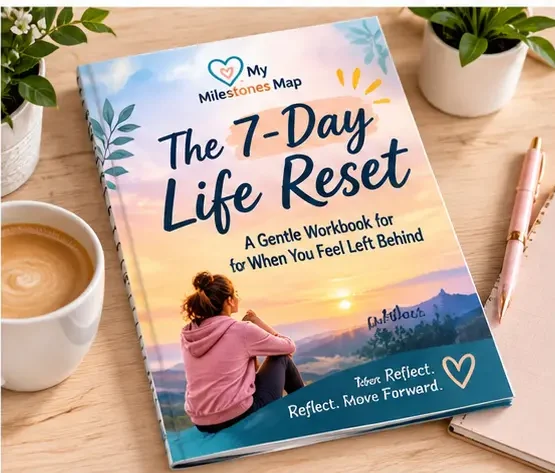
A Seven-Day Personal Reset
This is not a life overhaul. It is a week of small, manageable actions to help you pause, reflect and choose a next step. It is a practical exercise, not a treatment or a guaranteed solution to difficult feelings.
- Day 1: Name it. Write down in a few sentences how you feel about being “behind.” Do not try to fix or judge the feeling.
- Day 2: Find the borrowed goals. List three things you feel you should have achieved by now. Next to each one, ask honestly: do I actually want this, or do I feel I am supposed to want it?
- Day 3: Choose one area. Pick a single part of life to focus on for the next month.
- Day 4: Take a 15-minute step. Make one call, send one application or read one page about an opportunity. Then stop.
- Day 5: Take a break from comparison. Mute or limit the accounts that leave you feeling worse, just for today.
- Day 6: Talk to someone. Tell a trusted friend or family member how you have been feeling, or reach out to someone who has been through something similar.
- Day 7: Review and plan. Write down what you did and what you noticed. Choose one small action for next week.
If you miss a day, simply pick up where you left off. The point is to keep the promise gently, not perfectly.
It’s Not Too Late to Build a Life You Love
People change direction at many different ages. A parent returns to study after years of caring for children. Someone retrains in their forties after being made redundant. Another person slowly rebuilds their finances after a difficult period, or learns to trust again after a painful relationship.
These are possible paths, not promises that every change will be easy or turn out exactly as hoped. Life has real constraints. Money, responsibilities, health and opportunity can all affect what is possible. But a different timeline does not automatically mean there is no path forward.
Starting over is not the same as starting from nothing. You carry experience, resilience, knowledge of what has not worked and a clearer sense of what matters. Those are real assets, even when they do not look impressive on a CV.
You do not need to have everything figured out. You need a direction and a next step that is realistic for the life you have now. Your next chapter may look very different from your original plan, and it may be better suited to the person you have become.
Not every dream will come true. Some doors really do close, and it is okay to be sad about that. But other doors, different ones, may still be available. You can begin to find them by taking one step at a time.
A Reminder for the Person Who Feels Left Behind
Dear you,
You are tired. Maybe more tired than anyone around you realises. You have been carrying disappointment and trying to look fine in public, and that takes a lot of energy.
The feeling of being behind is heavy. It follows you into conversations, family gatherings and quiet moments at night. I will not tell you it is silly or that you should simply be grateful. It is not silly, and you should not have to pretend that everything is fine.
But I do want you to remember this: where you are right now is one chapter. It is not your whole story. The year that went badly, the plan that fell through and the things you have not done yet do not get the final word on who you are or what comes next.
You do not have to fix everything tonight. You only need one small step. One message sent. One page read. One honest conversation. One day of being slightly kinder to yourself than you were yesterday.
You are not alone in this, and you are not finished.
Frequently Asked Questions
Why do I feel like everyone is ahead of me?
One explanation is social comparison: people often evaluate themselves by comparing their lives, opinions or abilities with others [1]. Social media can create more opportunities for these comparisons, and research has linked upward social comparisons on Facebook with lower self-esteem in specific study settings [2]. When you add expectations about where you think you should be by a certain age, it can feel as though everyone else is moving forward while you are standing still.
Is it normal to feel left behind in life?
It is an understandable response to setbacks, major life changes or long periods of caring for others. Feeling behind does not mean you are a failure. If the feeling is persistent, overwhelming or affecting your daily life, consider speaking with a doctor or mental health professional.
How do I stop comparing my life to others?
You may not be able to stop comparing completely, but you can reduce the habit. Limit accounts that leave you feeling worse, remind yourself that social media shows only part of another person’s life, and spend time identifying what you genuinely want rather than what you feel expected to achieve.
What if I feel like I have wasted years of my life?
Those years may have been spent surviving, caring for others, healing or learning things that do not show on paper. You cannot get the time back, but you can recognise what it took to get through it and decide what you want to do with the time ahead.
Is 30, 40 or 50 too late to start over?
No age automatically rules out a new beginning. People retrain, change careers, return to education, rebuild finances and form new relationships at different stages of life. Your options and responsibilities may be different from those you had at twenty, so focus on a realistic next step rather than expecting a guaranteed outcome.
How do I find motivation when I feel stuck?
Do not wait for motivation to arrive before you begin. Choose one area of life and take a step so small that it feels manageable. Repeat it when you can. If low mood or feeling stuck lasts for weeks and affects your daily life, consider talking to a doctor or mental health professional.
Final Thoughts: It’s Not Over Yet
Life is not a race, and there is no single finish line. One disappointing chapter, even one that lasted years, does not decide the whole story.
You can be sad about what has not happened and still feel hopeful about what might. You can miss the person you thought you would become and still meet the person you are becoming.
You are allowed to begin again. You are allowed to change direction. And you are allowed to build a life that looks nothing like the one you originally planned.
It’s not over. Your life is still yours to build.
References
- Festinger, L. (1954). A Theory of Social Comparison Processes. Human Relations, 7(2), 117–140. https://doi.org/10.1177/001872675400700202
- Vogel, E. A., Rose, J. P., Roberts, L. R., & Eckles, K. (2014). Social Comparison, Social Media, and Self-Esteem. Psychology of Popular Media Culture, 3(4), 206–222. https://doi.org/10.1037/ppm0000047
- Neff, K. D. (2003). Self-Compassion: An Alternative Conceptualization of a Healthy Attitude Toward Oneself. Self and Identity, 2(2), 85–101. https://doi.org/10.1080/15298860390129863