
If you’ve ever walked past your three-year-old having a full, animated conversation with Alexa, Siri, or a talking stuffed animal complete with follow-up questions and a cheerful “goodnight, I love you” you’ve probably felt two things at once: charmed and a little unsettled.
It’s a strange thing to watch your toddler talk to a device as though it were another person.
And you’re not imagining the bigger question behind that moment.
AI-powered toys and conversational devices are moving further into children’s everyday lives. Some can answer questions, tell stories, remember previous interactions, and even present themselves as a friend or companion. At the same time, child-safety researchers are trying to work out what these new products mean for children who are still learning how relationships, trust, language, and emotions work.
The good news is that parents aren’t completely stuck with vague warnings anymore. There is now some specific guidance, independent testing, and emerging research to work with.
The not-so-good news?
We still don’t know everything.
Here’s what we currently know about AI chatbots, AI companion toys, and three-year-olds so you can make a decision on purpose rather than out of panic.
Is an AI Chatbot Safe for a 3-Year-Old?
- AI companion toys are different from ordinary voice assistants. Asking Alexa to play a song is a much simpler interaction than giving a three-year-old a toy designed to hold ongoing conversations and create a sense of companionship.
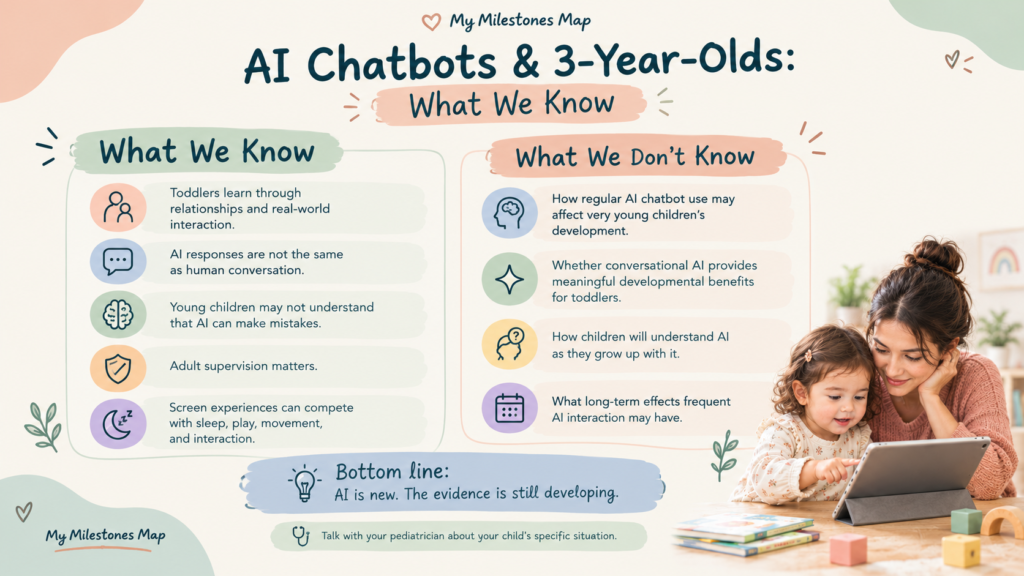
- Current guidance recommends avoiding AI chatbots and companion-style AI toys for children age 5 and under. Common Sense Media currently recommends that children five and under not use AI chatbots or AI toys.
- The long-term developmental research is still limited. We don’t yet have enough evidence to say exactly how regular AI-companion use affects the social, emotional, or language development of preschool-aged children.
- The biggest concern isn’t simply “screens”. It’s what an AI system is doing and what human interaction it might replace.
What Kind of AI Chatbot Is Appropriate for a 3-Year-Old?
Before we go any further, it helps to separate three things that often get lumped together under the label “AI chatbot.”
| Type | Examples | What it does | Why it matters for a 3-year-old |
| Voice assistants | Alexa, Siri, Google Assistant | Answers questions, plays music, sets timers, and responds to simple requests | Lower-stakes than a companion toy, but children can still misunderstand what the system knows or is capable of |
| AI companion toys | Grem, Bondu, Miko 3 | Holds ongoing conversations and may create a sense of personality or companionship | More concerning because the interaction is designed to feel social and ongoing |
| Open-ended AI companion apps | Character.AI and similar platforms | Supports extended conversations, role-play, and emotionally engaging interactions | Not developmentally appropriate for a three-year-old and generally aimed at much older users |
These categories aren’t interchangeable.
Asking Alexa to play a song is a short, task-based interaction.
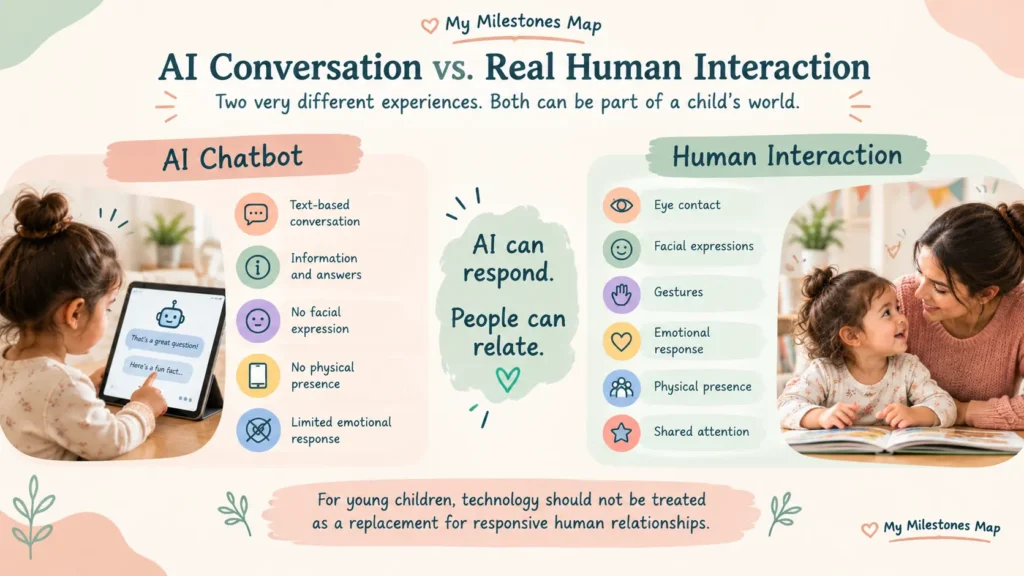
An AI companion toy can be very different. It may invite a child to keep talking, remember previous exchanges, respond as a personality, or present itself as a friend.
Open-ended AI companion apps go further still, allowing long, highly personal conversations that can become emotionally engaging.
This article focuses mainly on AI companion toys and similar child-facing conversational tools not ordinary voice-assistant commands, and not the separate issue of teenagers using open-ended AI companion apps.
What Do Experts Recommend About AI Chatbots for 3-Year-Olds?
For a three-year-old, the current recommendation is fairly straightforward: avoid AI chatbots and AI companion toys.
Common Sense Media’s current guidance recommends no AI chatbots for children age 5 and under. Its January 2026 assessment of AI toys likewise recommends that children five and under not use them.
That doesn’t mean every interaction with a device carrying the word “AI” is equally risky.
A preschooler asking Alexa to play “Twinkle, Twinkle Little Star” is not doing the same thing as a child spending long periods talking with an AI toy designed to act like a friend.
That distinction matters.
And it’s also where the evidence gets thinner: much of the existing research on children’s interactions with voice assistants has involved school-aged children rather than three-year-olds.
So when we talk about toddlers, we should be careful not to pretend the science is more settled than it is.
Why Are Experts Concerned About AI Chatbots for Young Children?
Researchers’ concerns aren’t simply about “technology being bad for kids.”
They’re focused on several more specific issues.
Young children can treat technology in surprisingly social ways
Children don’t always interact with conversational technology as though it’s just another household appliance.
Research on children’s interactions with voice assistants has found that children may attribute human-like qualities to them, including intelligence, agency, feelings, or social intentions. One study of children ages 6 to 11 found that many children overestimated what smart speakers could think or know and were sometimes uncertain about whether the devices had feelings or agency.
That doesn’t mean a three-year-old literally believes Alexa is a human being.
It does mean that young children can make social sense of technology that talks, responds, and behaves in human-like ways.
And the younger the child, the less useful it is to assume they interpret these interactions exactly as adults do.
The responsiveness is part of what makes AI companions different
There’s another concept researchers are paying attention to: social contingency.
Very simply, it’s the back-and-forth rhythm of interaction—your child does something, another person responds, your child reacts, and the exchange continues.
That kind of responsive interaction is an important part of how children learn language, communication, and social behavior.
AI systems can imitate some of that rhythm remarkably well.
They answer questions.
They react immediately.
They remember things.
They can sound encouraging, funny, curious, or caring.
The unanswered question is what it means when some of that responsiveness comes from a machine rather than a person.
That is an active research question not proof that AI toys cause developmental harm.
Research involving children and voice assistants has already shown that children can engage with these systems socially, including trying to build relationships with them. But the existing studies are mostly based on school-aged children, not toddlers.
That distinction is important.
Some AI systems can be overly agreeable
Another concern is over-agreeableness.
Conversational AI is often optimized to keep an interaction going and respond in a pleasant, cooperative way. That can be useful in some settings, but it is not necessarily how healthy human relationships work.
Parents say no.
Siblings disagree.
Teachers correct children.
Friends sometimes refuse to go along with an idea.
That friction is part of ordinary social learning.
An AI that constantly validates a child’s ideas or keeps trying to maintain the conversation could create a very different kind of interaction.
The concern isn’t that every AI toy “always agrees.”
It’s that conversational systems can be designed around engagement and responsiveness in ways that don’t naturally include the boundaries, disagreement, and unpredictability found in human relationships.
Privacy is a real concern not a hypothetical one
There is also a much less philosophical problem: what happens to everything your child says?
AI toys can be internet-connected devices that use voice recordings, conversation transcripts, usage patterns, and other information to provide their responses.
Common Sense Media’s January 2026 assessment found extensive data-collection concerns around AI toys, including voice and behavioral information. It also reported that some products can listen continuously or collect information in children’s private spaces.
A three-year-old obviously cannot meaningfully understand or consent to that kind of data collection.
That’s why parents need to look beyond the cute face on the box.
Safety failures have already happened
This is one area where parents don’t have to rely only on predictions.
In January 2026, security researchers discovered that the web portal associated with Bondu AI toys exposed nearly 50,000 conversation transcripts involving children. The system was intended partly for parents and company staff, but researchers found that the conversations could be accessed with a Gmail account.
And in November 2025, U.S. PIRG’s Trouble in Toyland investigation raised concerns about AI-enabled toys after testing found that FoloToy’s Kumma bear could provide inappropriate sexual content and information involving potentially dangerous household objects. Following the report, sales of the toy were suspended, although the product was later reported to have returned to sale after a safety review.
These incidents don’t prove that every AI toy is unsafe.
They do show why “it’s just a toy” isn’t a sufficient safety argument when the toy is connected to an AI system.
Not every manufacturer agrees with every finding
This part matters, too.
AI toy companies have disputed some independent testing findings and have argued that their products include child-specific safeguards.
Common Sense Media tested Grem, Bondu, and Miko 3 using test accounts configured for ages 6 to 13, and its assessment rated the products as presenting unacceptable risks. The company-level responses and disagreements are part of an evolving debate around how these products should be evaluated.
So the evidence we have today comes from several places: peer-reviewed research, developmental science, independent product testing, and security investigations.
Those sources answer different questions.
And none gives us a complete long-term picture of what regular AI-companion use will mean for preschoolers.
What Do We Actually Know From Research?
This is where I think parents deserve a little honesty.
We have evidence that children can interact socially with voice technologies.
We have evidence that conversational AI can sometimes give inappropriate or unreliable answers.
We have evidence that AI toys can collect sensitive information.
And we have independent testing showing that child-facing AI systems can fail at safety boundaries.
What we don’t yet have is decades of research showing exactly what happens to a three-year-old’s development after years of regular conversations with an AI companion.
We don’t yet have strong long-term evidence answering questions such as:
- Does frequent AI-companion use affect language development?
- Does it change pretend play?
- Does it influence how children understand trust or relationships?
- Could it reduce the amount of human conversation a child gets?
- Does it affect emotional regulation or social problem-solving?
Those are legitimate research questions.
They’re not settled conclusions.
Can a 3-Year-Old Use Alexa or Siri?
Basic voice assistants are a different story.
And honestly, the research here is thinner and more mixed.
Studies involving children have found that kids can treat voice assistants in social ways, sometimes overestimating their intelligence or attributing human-like qualities to them. Other research has found that voice assistants don’t always understand children’s speech accurately, particularly in more natural conversations.
One study of 28 children aged 5 to 10 found that a commercial voice assistant produced meaningful, on-topic responses to children’s utterances only about half of the time during unstructured conversation. The children also frequently tried to build relationships with the device.
Again, these weren’t three-year-olds.
So I wouldn’t turn that research into a dramatic warning about a preschooler asking Alexa for a song.
If your three-year-old asks Alexa how many legs a spider has, tells it to play music, or asks about the weather, that’s meaningfully different from giving the child an always-available AI “friend.”
A simple sentence can also help:
“Alexa isn’t a person. It’s a computer that can answer some questions and do certain things.”
You don’t need to turn every interaction into a technology lecture.
Just help your child build an accurate mental model.
What Should I Do If My 3-Year-Old Already Has an AI Toy?
First: don’t panic.
You haven’t failed your child.
AI toys arrived quickly, and many of them are marketed as educational, entertaining, and convenient. Common Sense Media’s January 2026 survey found that nearly half of parents had purchased or considered purchasing AI-enabled toys or devices for their children.
If an AI companion toy is already in your house, start by asking a few practical questions.
Does it listen all the time?
Find out when the microphone is active and whether voice data is being recorded.
What happens to your child’s conversations?
Look for information about recordings, transcripts, storage, deletion, and third-party sharing.
Can you review what the toy has been saying?
A parent dashboard or conversation history can at least give you some visibility into what’s happening.
What happens when the child asks something inappropriate?
Don’t rely on the phrase “kid-safe” on the packaging. Look for actual information about safety testing and content moderation.
Is the toy designed as a companion?
There’s a meaningful difference between “Ask me what this animal is” and “I’m your best friend; talk to me whenever you’re lonely.”
That difference matters.
The goal doesn’t have to be perfection.
It can be boundaries.
Keep it supervised.
For a three-year-old, use conversational AI alongside an adult rather than allowing long, unsupervised conversations.
Avoid treating the AI as a friend or emotional caregiver.
A computer can answer questions. It can’t replace a parent, grandparent, teacher, or trusted caregiver.
Explain what the device is.
You don’t need technical language. “It’s a computer that talks” is enough for a young child.
Protect privacy.
Check microphone settings, recordings, transcripts, account permissions, and the company’s privacy policy before making an AI toy part of everyday play.
Watch what it’s replacing.
This may be the most useful question of all.
If the AI is replacing a few seconds of asking for a song, that’s one thing.
If it’s replacing story time, pretend play, conversation, comfort, or time spent talking with people, that’s something else.
What We Still Need to Learn
There is a huge gap between a new product appearing on store shelves and researchers having enough time to understand its long-term effects.
For AI companions, that gap matters.
We still need research that follows young children over time and looks at how regular interaction with conversational AI affects:
- language and communication
- pretend and imaginative play
- social understanding
- emotional development
- trust and relationship concepts
- reliance on technology for comfort or conversation
Researchers have already raised concerns about whether conversational systems could blur the boundary between tools and social relationships for children. But concern isn’t the same thing as proof.
That distinction is worth protecting.
Parents deserve facts not panic.
Frequently Asked Questions About AI Chatbots for Toddlers
Is it safe for a 3-year-old to talk to Alexa or Siri?
Basic voice-assistant use is a different and lower-stakes category from an AI companion toy. There isn’t a comparable recommendation specifically saying that every three-year-old should never speak to Alexa or Siri. However, research shows that children can misunderstand the capabilities or human-like qualities of conversational assistants, so adult awareness and simple explanations are helpful.
What’s the difference between a voice assistant and an AI companion toy?
A voice assistant is usually designed around tasks: playing music, answering a question, setting a timer, or providing information.
An AI companion toy is designed for longer interactions. It may maintain a personality, encourage continued conversation, remember past exchanges, or present itself as a companion.
That social design is a major reason child-safety researchers are more concerned about companion-style AI.
Why does Common Sense Media recommend against AI toys for young children?
Its January 2026 assessment identified concerns involving emotional attachment, privacy, unreliable performance, and inappropriate content. Its testing of three AI toys found that 27% of outputs were inappropriate for children in the test scenarios, including responses involving mature topics, risky advice, and unsafe role-play. The products were tested using accounts configured for ages 6 to 13—not three-year-olds specifically.
Is this the same issue as the AI companion concerns involving teenagers?
Related, but not identical.
For teenagers, concerns can center on emotional dependence, harmful content, and the possibility of AI companions interfering with real-world relationships. For toddlers, the concern is less about independent digital relationships and more about introducing companion-style technology during a period when children are still developing their understanding of language, trust, emotions, and social relationships.
What should I do if my child already has an AI companion toy?
You haven’t done anything wrong.
Start with supervision, privacy checks, and clear boundaries. Keep the toy in shared family spaces rather than treating it as a private bedtime companion, and make sure human conversation, play, books, and emotional connection remain central parts of your child’s day.
What’s actually happening developmentally when a toddler talks to an AI toy?
Researchers are particularly interested in the idea of social contingency the back-and-forth structure of interaction in which one person acts and another responds.
AI can imitate some of that responsiveness. What researchers are still trying to understand is how young children interpret machine responsiveness and whether repeated interaction with conversational AI changes anything about how they learn social cues and relationships.
At the moment, that is an open research question rather than a proven developmental effect.
Are any AI-adjacent tools lower-risk for young children?
Tools that answer a specific question and then stop are generally less socially immersive than companion products designed to maintain an ongoing “friendship.”
But lower-risk does not automatically mean risk-free, and research specifically examining preschool-aged children is still limited.
So, Should a 3-Year-Old Talk to an AI Chatbot?
Here’s where I land after looking at the evidence.
For a three-year-old, I wouldn’t choose an AI chatbot or companion toy as part of their regular play.
That’s not because AI is automatically dangerous.
It’s because three-year-olds don’t need an artificial relationship to give them something that real people, books, pretend play, music, curiosity, and everyday conversation already provide and those human experiences come with developmental benefits that an AI system can’t reproduce in the same way.
A child asking Alexa to play a song is a very different situation from a toy designed to become their conversational companion.
The question I think is most useful for parents isn’t:
“Is AI good or bad?”
It’s:
“What is this AI replacing?”
If it replaces a few seconds of asking for a song, the stakes are relatively small.
If it starts replacing story time, pretend play, conversation, comfort, or the back-and-forth of human relationships, the question becomes much more important.
And you don’t have to get this perfectly right.
You just need enough information to make the choice deliberately, instead of by default.
Because when it comes to a three-year-old, the technology may be new.
Their need for real people isn’t.
Sources & Further Reading
Common Sense Media AI Chatbots and Your Child: Age and Stage Guidance
Common Sense Media Youth AI Safety Institute AI Toys Risk Assessment
Common Sense Media AI in the Toy Box: How Parents View AI-Enabled Toys for Young Children
WIRED An AI Toy Exposed 50,000 Logs of Its Chats With Kids to Anyone With a Gmail Account
Computers and Education: Artificial Intelligence “Alexa doesn’t have that many feelings”: Children’s understanding of AI through interactions with smart speakers in their homes
Journal of Child-Computer Interaction Research on children’s speech and interactions with voice assistants
Integrative Psychological & Behavioral Science Anthropomorphizing Technology: A Conceptual Review of Anthropomorphism Research and How it Relates to Children’s Engagements with Digital Voice Assistants
U.S. PIRG Education Fund Trouble in Toyland 2025
This article is for general informational purposes and reflects publicly available research, safety testing, and expert guidance available as of September 2026. Research and recommendations in this area are evolving quickly. It is not medical, psychological, or developmental advice. For concerns about your individual child’s development or technology use, speak with your pediatrician or another qualified child-development professional.