
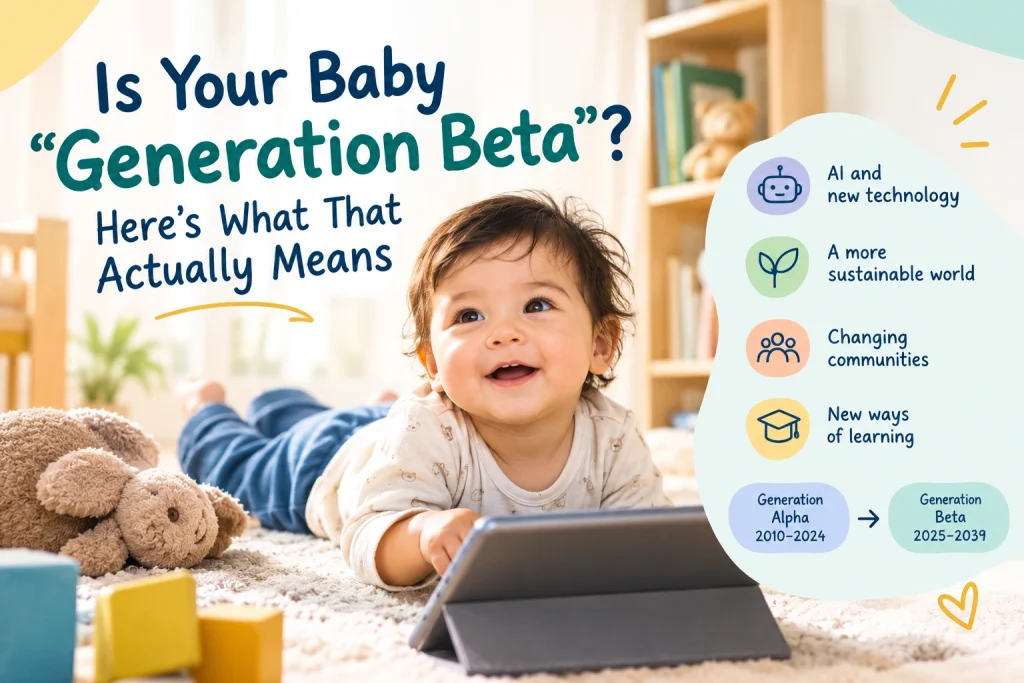
Is Your Baby “Generation Beta”? Here’s What That Actually Means
If you’ve scrolled through your phone one-handed while a newborn slept on your chest and landed on a headline about “Generation Beta,” you’re not imagining things it’s everywhere right now. Baby name lists, parenting podcasts, maybe even a relative texting the group chat: “Did you know your baby is part of a whole new generation?”
It’s a lot to take in when you’re still figuring out swaddling.
Here’s the short version: Generation Beta isn’t a medical term, a developmental stage, or something you need to prepare for. It’s a label created by social researchers to describe children born from 2025 onward. That’s genuinely it. But because it touches on real things (technology, screen time, how fast the world is changing), it’s worth understanding what it actually means, where it came from, and how much weight to give it. This guide walks through all of that, plainly and without the hype.
What Is Generation Beta, Exactly?
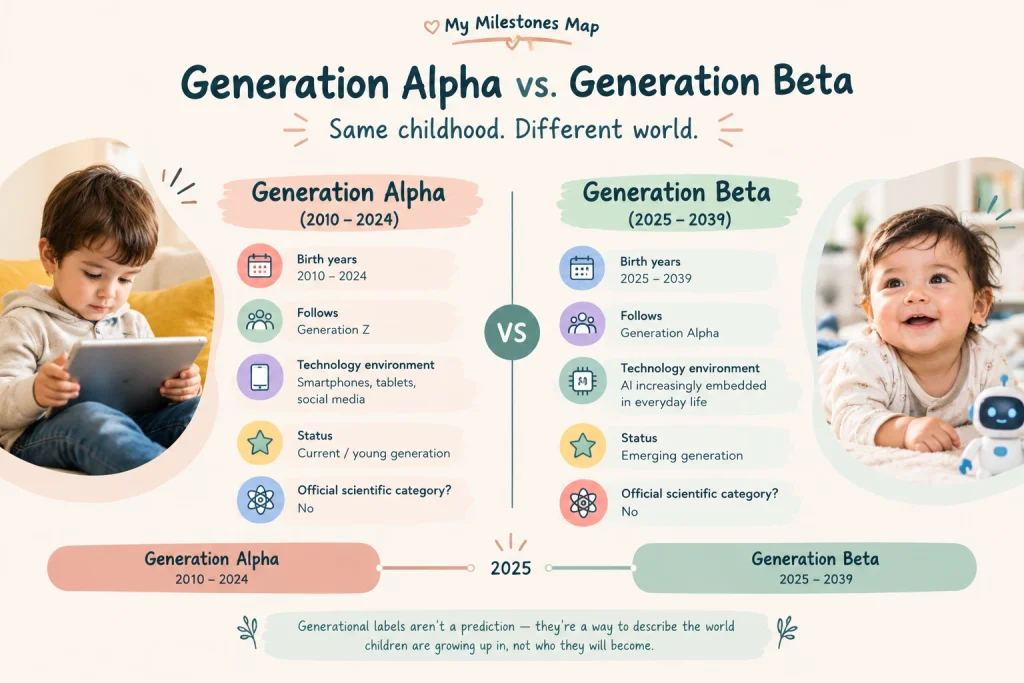
Generation Beta refers to children born between 2025 and 2039. It’s the label that follows Generation Alpha (born 2010–2024), coined by McCrindle, the Australian social research agency that named Generation Alpha too. If your child was born in 2025 or later, they’re technically part of this cohort.
Generational labels like this aren’t official government categories there’s no international committee that rules on exactly when one generation ends and another begins. They’re a framework researchers use to describe broad shifts in the world children are growing up in: available technology, economic conditions, and the cultural moment shaping their early years. By the time the cohort closes in 2039, McCrindle’s own estimates put Generation Beta at around 16% of the global population.
Is Generation Beta an official scientific category?
No. Generation Beta is a social and demographic label, not a medical or developmental classification. The 2025–2039 range comes primarily from McCrindle’s framework, and other researchers may use different boundaries.
Where Did the Name Come From?
After Generation Z, McCrindle chose to continue the naming sequence using the Greek alphabet, beginning with Alpha and then Beta. The shift wasn’t just cosmetic McCrindle has described Alpha and Beta as the first generations shaped by an entirely different kind of world, one where digital and physical life mostly blend together. Researchers have already floated a name for whatever comes after Beta (Generation Gamma, starting around 2040), though that’s obviously not something you need to think about yet.
What Actually Makes Generation Beta Different From Generation Alpha?
Their Defining Technology: AI, From Day One
Every generation gets defined partly by the technology that shaped its childhood. Gen Z grew up alongside social media. Generation Alpha grew up with smartphones and tablets already in hand. Generation Beta is commonly described as the first generation expected to grow up with generative AI present from the beginning of their lives. It’s simply part of the background, the way electricity or the internet is for older generations.
That doesn’t mean every Gen Beta toddler is using AI tools directly (most one-year-olds are busy with more pressing research, like whether a spoon also functions as a drum). It means AI is woven into the products and systems around them from birth how content gets recommended, how learning apps adapt, how home devices respond when AI chatbots and young kids end up in the same room.
Growing Up in a Sustainability-Focused, More Connected World
Researchers also point to bigger forces that may shape this generation, including climate change, shifting population patterns, urbanization, and technological change. McCrindle identifies sustainability and other large-scale social changes as factors likely to influence the world Generation Beta grows up in.
Who’s Actually Raising Generation Beta?
This is arguably the more useful part of the conversation, because it’s about you, not a hypothetical future headline.
Many Generation Beta children will be raised by younger Millennials and older Gen Z parents, although the mix will vary across countries and families. McCrindle’s research describes values it expects to become increasingly important among the parents raising this generation, including adaptability, equality, and environmental awareness. Many of these parents also grew up online themselves, which may shape how they think about their children’s relationship with technology.
If that sounds familiar, you’re not “doing Generation Beta parenting” as some new system. You’re parenting in the world you’re living in researchers simply gave the children growing up in that world a label.
The biggest difference isn’t something biological about the children themselves. It’s the technological and social environment they’re expected to grow up in.
What About AI and My Child’s Privacy?
AI won’t just show up through chatbots. It may become part of toys, learning platforms, voice assistants, cameras, and other products children encounter at home. For parents, that means the conversation isn’t only about how much technology children use. It’s also worth asking what information a product collects, where that information goes, and whether a child really needs the technology in the first place.
Is “Generation Beta” an Official Classification, or Just a Trend Piece?
Worth saying clearly: generational cohorts like Beta, Alpha, and even Gen Z or Millennials don’t have hard scientific boundaries. Different researchers sometimes use slightly different start and end years. These labels come from social and market research, not biology or child development science; they’re a useful shorthand, not a diagnosis or a prediction of who your child will become.
That’s not a knock on the concept. It’s genuinely useful for understanding broad cultural shifts. It’s just worth holding loosely rather than treating as a fixed identity your child was born into.
Why “New Generation” Headlines Can Feel Like One More Thing to Worry About
If reading about Generation Beta gave you a small flicker of “great, one more thing I have to get right,” that reaction makes sense, and you’re not alone in it. Every generation of parents has faced some version of this. Baby boomers were warned television would shorten kids’ attention spans. Gen X parents got cautioned about video games. Millennial parents got an entire industry built around screen-time guilt.
Generational trend pieces tend to arrive with an undertone of urgency, even when the underlying research is genuinely just descriptive, not prescriptive. It can help to remember: researchers are describing a pattern after the fact they’re not handing you a rulebook you’re already behind on.
Does Any of This Actually Change How You Should Parent?
Not as much as headlines might suggest.
The fundamentals of supportive parenting haven’t suddenly changed because a new generation has been named. Warmth, responsiveness, consistency, connection, and appropriate boundaries remain important parts of healthy parenting.
- Screen time and digital tools. The conversation has shifted from “how many hours” to “what kind of content, and what is it displacing.” We go deep on the specifics in our guide to the AAP’s updated screen-time guidance.
- AI as a household presence. Not just a novelty smart speakers, AI-assisted learning apps, and similar tools showing up earlier than most parents expected.
- Talking about big topics earlier. Like sustainability and change, in age-appropriate ways.
- Protecting old-fashioned things on purpose. Unstructured play, boredom, in-person connection because they no longer happen by default the way they used to. Our list of screen-free activities that actually hold a toddler’s attention is a good place to start.
None of this requires a new parenting philosophy. It mostly means staying intentional about things earlier generations didn’t have to think about as consciously.
Frequently Asked Questions About Generation Beta
What years does Generation Beta cover?
Generation Beta generally refers to children born from 2025 through 2039, following Generation Alpha, which McCrindle Research defines as 2010–2024. These dates come from a generational framework rather than an official scientific or government classification.
Is Generation Beta a real or official generation?
Generation Beta is a generational label, not an official scientific or government classification. The term was introduced by McCrindle Research, and other researchers may use different names or birth-year boundaries when describing generations.
What generation is a baby born in 2025?
A baby born in 2025 is generally considered Generation Beta under McCrindle Research’s framework. However, generational labels are social-research categories, so the definition may vary depending on the source.
What generation comes after Generation Alpha?
Generation Beta comes after Generation Alpha in McCrindle’s framework. Generation Alpha is defined as 2010–2024, while Generation Beta is defined as 2025–2039.
What is the difference between Generation Alpha and Generation Beta?
The biggest expected difference is the technological environment they grow up in. Generation Alpha experienced the rapid expansion of smartphones, tablets, social media, and digital platforms. Generation Beta is expected to grow up with artificial intelligence increasingly integrated into everyday life, including education, entertainment, and everyday services.
This does not mean Generation Beta children will be biologically or inherently different from Generation Alpha. Their experiences will be shaped by the environment around them, including how families, schools, and society use technology.
Who are the parents of Generation Beta?
Generation Beta will be raised by a mix of older Gen Z adults, younger Millennials, and other parents, depending on the child’s family and circumstances. Researchers have described younger parents as increasingly interested in adaptability, equality, sustainability, and thoughtful technology use, but parenting styles vary widely from family to family.
Do I need to parent differently because my child is Generation Beta?
Not fundamentally. Children still need warmth, responsive care, boundaries, connection, sleep, play, and opportunities to explore the world around them.
What may require more attention is the changing environment around them. Parents of Generation Beta may need to think more intentionally about AI, screen use, digital privacy, online safety, and protecting unstructured play and real-world interaction.
When does Generation Beta end, and what comes after it?
Under McCrindle’s framework, Generation Beta ends in 2039. The generation that follows has been referred to as Generation Gamma, although that label is not an established or official classification and is not something parents need to worry about today.
Final Thoughts
Generation Beta is a useful label, not a life sentence. It’s shorthand for “kids growing up with AI as background noise, in a world more focused on sustainability and connectivity than the one their parents knew as children.” That’s genuinely worth understanding.
But your child isn’t a case study; they’re a specific, particular kid who happens to have been born in a specific stretch of history. The label can inform how you think about technology, values, and the world you’re raising them in. It shouldn’t replace paying attention to who they actually are.
External Sources
- McCrindle Research “Welcome Generation Beta”
Read the McCrindle Research article - McCrindle Research “Gen Beta Characteristics”
Read the McCrindle Research article - American Academy of Pediatrics “Digital Ecosystems, Children, and Adolescents: Policy Statement” (2026)
Read the AAP policy statement - Pew Research Center “How Parents Manage Screen Time for Kids” (2025)
Read the Pew Research Center report
This article is for general informational purposes and reflects publicly available research as of September 2026. It isn’t medical, developmental, or psychological advice for guidance specific to your child, talk with your pediatrician.