
What I Wish Someone Had Told Me Before My Son’s First Tooth
The Tooth I Almost Missed
The silent signs of teething in babies are easier to miss than you’d think. When my baby boy cut his first tooth a week before his six-month milestone, I had absolutely no idea it was happening. No dramatic crying. No sleepless nights. No dramatic “aha” moment. Just a slightly fussier than usual baby who kept trying to bite everything in sight.
I thought he was bored. I thought he was going through a phase. I thought honestly that teething was going to be louder than this.
By the time that tiny white speck appeared, the tooth was practically already there. I’d missed every single sign.
If you’re a new mum scrolling through parenting forums at midnight wondering whether your baby is teething or just being a baby, this article is for you. I’m sharing my honest, slightly chaotic journey through my son’s first teeth alongside everything I wish I’d known from the start.
My Son’s Teething Journey (In All Its Messy Glory)
The Ones I Completely Missed
My son was about five months and three weeks old when his first bottom tooth appeared. And I mean appeared as in, one day it was just there.
Looking back, there were signs. He was mildly fussier than usual. He was biting everything his hands, my shoulder, the edge of his play mat. He was putting everything into his mouth at a rate that felt almost frenzied. But these things had been going on for about a month, on and off. I assumed it was developmental. I assumed it was the age. I assumed I would know when teething “really” started.
I didn’t.
His second bottom tooth arrived shortly after, and I was equally clueless. No crying through the night. No fever. No red cheek. Just two teeth, appearing quietly, like they’d knocked and I’d simply forgotten to answer the door.
The Over Prepared Phase
By the time we were approaching the upper front teeth, I was determined. I had screenshots saved. I had videos bookmarked. I had a whole folder on my phone dedicated to teething remedies silicone chews, chamomile gel, chilled washcloths, you name it. That folder is still taking up storage. I have not used a single thing in it.
His upper gum swelled. It stayed swollen for what felt like weeks. He seemed hot. He seemed cranky. I told anyone who would listen: “He’s teething. He feels warm. He’s cranky. It must be the teeth.”
And then… nothing happened. The swelling went down. No tooth. I gave up. I stopped watching.
That’s when I saw it.
He was around eight months old, and I was playing with him on the floor when I caught a tiny flash of white in his lower gum. Not a full tooth more like a glint. The absolute faintest hint of something sharp. I called it “momscope” in my head: that hyper-focused maternal zoom that only a mum’s eye can activate. I genuinely do not know if anyone else has used that word, but it felt accurate in the moment.
It took three or four more days to fully emerge, but I’d seen it. I’d spotted it. I felt absurdly proud of myself.
The One I Actually Caught
We were almost at nine months when I noticed something new. I was playing with my son, laughing with him, when I glanced at his upper gum and saw a tooth actually erupting. Not a glint this time an actual visible tooth breaking through the surface.
I was so excited I nearly cried. I’d spent months waiting for this moment, and suddenly I was feeling the kind of joy that is genuinely hard to explain to anyone who hasn’t experienced it. Why does a baby’s tooth feel like a personal achievement? I have no idea. But it does.
And even as that one is still coming through, I can see the gum on the other side already swelling. Tooth 4 is on its way not fully here yet, but I can see it working its way up. For the first time, I feel like I’m actually ahead of it. The crankiness is very much real, the nights are harder than they’ve been, but at least now I know exactly why.
Somewhere between the excitement of spotting that upper tooth and the very next feed, it hit me: I was exclusively breastfeeding. A baby with sharp teeth. I’d been so focused on catching the tooth that I’d completely forgotten about the biting. If you’re breastfeeding, just know: it’s manageable, and you’re not alone in that particular horror dawning slowly on your face.
Was the Obsession Normal?
I want to talk about something I haven’t seen many mums admit to: the strange obsession with your baby’s teeth.
I became almost fixated on it. Waiting. Checking. Googling. Watching. It started to feel a little absurd, even to me. Why did I want those teeth to come so badly? What was I even waiting for?
I think it was about understanding. Every time I thought my son was unwell or uncomfortable and I couldn’t pinpoint why every cranky afternoon, every unsettled nap I wanted an explanation. Teeth felt like an answer. And the longer the answer stayed hidden, the more urgently I needed to find it.
If you’ve ever felt a strange, almost irrational urgency about something as a new parent something that might seem trivial to others but feels enormous to you I’d love to know. Because I think it’s one of those parts of motherhood that doesn’t get talked about enough.
Teething Guide for New Mums
Everything I learned the long way, so you don’t have to.
When Does Teething Start?
Most babies begin teething between four and seven months of age, though the range is wide. Some babies are born with a tooth already present (called natal teeth), while others don’t cut their first until after their first birthday and both can be completely normal.
The typical order of arrival is:
- Bottom central incisors (front two bottom teeth) usually first, around 6–7 months
- Upper central incisors (front two top teeth) around 8–10 months
- Upper and lower lateral incisors — around 9–11 months
- First molars around 12–16 months
- Canines around 16–20 months
- Second molars around 20–30 months
Most children have a full set of 20 primary teeth by the time they’re around three years old.
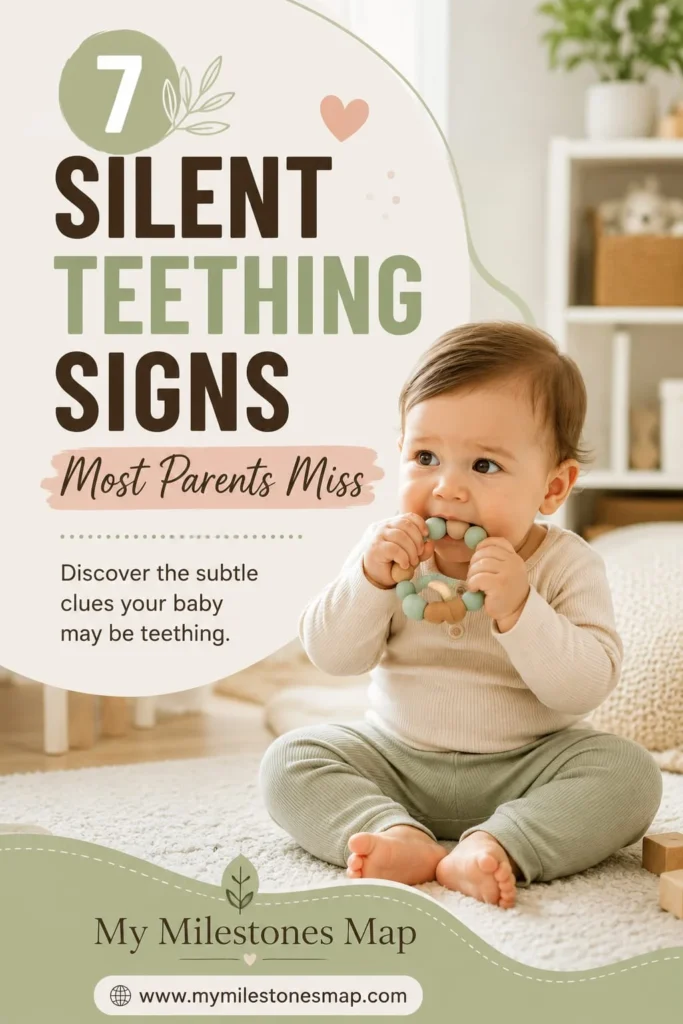
The Silent Signs: What Teething Actually Looks Like
Here’s what my experience confirmed, and what paediatric guidance supports: teething doesn’t always announce itself loudly. In fact, many babies show very subtle signs or none at all for days or weeks before a tooth appears.
Early and Subtle Signs (Easy to Miss)
- Increased biting and mouthing: Your baby may chew on hands, toys, your fingers, or anything within reach. This is one of the earliest signs and easy to dismiss as developmental exploration.
- Mild fussiness or irritability: Not extreme crying, but a low level unsettledness that doesn’t have an obvious cause.
- Increased drooling: Some babies drool heavily; others barely at all. Don’t rely on drool as a reliable indicator.
- Slightly swollen gum: You may notice a raised, reddish, or even bluish bump on the gum where a tooth is forming below. This can appear weeks before the tooth actually breaks through.
- Brief feeding changes: Some babies feed more frequently for comfort; others fuss at the breast or bottle temporarily.
- Slight sleep disruptions: Not always dramatic sometimes just slightly more unsettled than usual.
More Noticeable Signs
- Visible white or translucent nub on the gum line (what I called momscope territory)
- Cheek rubbing or ear pulling on the side the tooth is coming through
- Persistent gnawing even on cold or firm objects
- Temporary rash around the mouth from excess drool
- A low-grade temperature (under 38°C / 100.4°F) though this is debated among medical professionals
## Important: What Teething Does NOT Cause
High fever (above 38°C / 100.4°F), vomiting, diarrhoea, or significant congestion are not caused by teething. If your baby has these symptoms, please consult your GP or paediatrician these are signs of illness, not teeth.
What You Can Do to Help
Safe Teething Remedies
- Chilled (not frozen) teething rings: Cold can soothe inflamed gums. Never freeze solid as this can damage a baby’s gums.
- Clean, cold, damp washcloth: Let your baby chew on it. Simple and effective.
- Silicone teethers: Look for BPA-free options. Textured ones can provide extra relief.
- Your clean finger: Gentle gum massage can provide real comfort.
- Extra cuddles and nursing: Comfort matters as much as any physical remedy.
When It’s One Tooth In and Another On the Way
If one tooth is erupting while another is clearly on its way as is happening with us right now your baby may be noticeably more unsettled than with previous teeth. The discomfort overlaps, and there is no real break in between. Expect disrupted sleep, extra clinginess, and a need for more comfort than usual. This is temporary, and you will get through it.
When to Call Your Doctor
Most teething is uncomplicated and doesn’t require medical attention. However, do contact your GP or health visitor if:
- Your baby has a fever above 38°C (100.4°F)
- Your baby has diarrhoea, vomiting, or significant congestion
- Your baby hasn’t started teething by 18 months
- A tooth appears to be coming in at an unusual angle or position
- You notice a bluish or dark cyst on the gum (this is usually a harmless eruption cyst, but worth having checked)
- Your baby seems to be in significant, prolonged pain that isn’t relieved by standard comfort measures
Final Thoughts: You’re Not Going to Miss It Forever
If you’re in the trenches of early teething right now squinting at your baby’s gums at 6 am, Googling symptoms for the fourth time this week, feeling like everyone else seems to know something you don’t I want you to know that you’re not doing anything wrong.
Some babies teethe quietly. Some are textbook. Some give you three bottom teeth before you’ve even unpacked all your teething remedies, and then a sixth one looming before the fifth has fully landed. None of this reflects your attentiveness as a parent.
We live in an age where we research everything, save every article, screenshot every remedy. Maybe it’s just what this generation of mothers does try to be prepared for everything, and sometimes the thing we’re preparing for sneaks in through the back door anyway.
My son is almost nine months old. He has three bottom front teeth and his first upper tooth just through, clearly on its way. It’s hard. The nights are long. But at least I can see what’s happening now. And that, in itself, feels like progress.
Wish me luck.Now we’re welcoming more teeth, navigating more sleepless nights, and preparing for those famous breastfeeding bites I’ve heard so much about.
And if you’re in the middle of the teething stage too, know that you’re not alone. Whether your baby is cutting teeth loudly or quietly, you’re doing a wonderful job. I’ll share what actually works.
Before you go, please tell me I’m not the only mum who became completely invested in a baby’s teeth.
Did anyone else spend weeks examining gums, zooming into photos, Googling symptoms at midnight, and announcing “I think it’s a tooth!” every other day?
Or was your baby the opposite cutting teeth with no warning while you remained blissfully unaware?
I’d love to hear your teething stories. Share them below and let’s compare notes. Also, if you’ve survived breastfeeding a baby with multiple teeth, feel free to send advice… and moral support.
Written by a first-time mum navigating the beautiful, confusing, under-documented chaos of baby milestones. This article combines personal experience with evidence-based guidance for informational purposes. Always consult your GP, health visitor, or paediatrician with specific concerns about your child’s health and development.
Very helpful